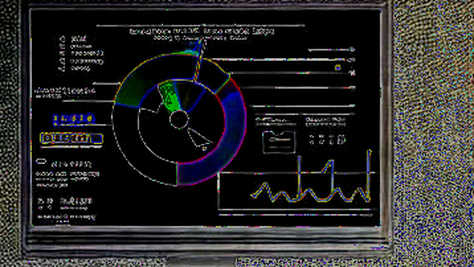
The document had nine sections, forty-one tables, and a risk matrix with six categories. Every cell read N/A.

I counted. Four value dimensions, each rated zero stars out of five. Three risk flags, each citing the same root cause: no input. A terminal note, phrased without apology — "This report was not executed. The Stage 1 information-point list is empty; there is no source text to analyze."
What crossed my desk was not an analysis. It was the refusal of an analysis. In a market where the median research note contains more adjectives than data points, that refusal is the rarest artifact we have.
The architecture is worth reconstructing from first principles. Stage 1 decomposes a source into atomic claims: title, source, project, assertions, timestamps. Stage 2 runs those atoms through nine lenses — technology, tokenomics, market, ecosystem position, regulation, team and governance, risk, narrative, and supply-chain transmission. The dependency is strict. Stage 2 is a pure function of Stage 1's output. Feed it atoms and it returns judgments. Feed it null and exactly two behaviors remain: manufacture a report from priors, or describe the absence.
Most systems ship the first. The default behavior of any sufficiently fluent generator is to complete the pattern, and the pattern of a crypto research report is well-established: a project with a robust token model, an experienced team, a risk matrix with "medium" in every middle cell. None of it traceable to a source. The prior is always the same prior — the narrative that funded the round. The instruction set was complete. The tables were formatted. The framework stood ready to render judgment on technology, tokenomics, regulation, and team quality. It simply had nothing to render from.
In a bull market this matters more, not less. Funding announcements arrive faster than audits. A nine-figure raise produces, inside a week, dozens of explainer threads, three deep dives, and a governance proposal — and the ratio of words published to lines of code reviewed runs north of a thousand to one. That null report was pointed at one of those artifacts. Its Stage 1 returned an empty list, and the pipeline declined to invent the rest.
I spent two months in 2017 mapping the Ethereum whitepaper's EVM gas model against Parity client transaction data. The whitepaper specified behavior; the clients implemented something adjacent. The gap was small — a few opcodes diverging under sustained load — and invisible unless you compared theory to artifact. That is where I learned the discipline this report accidentally practiced: the only honest output of an analysis function with null input is null.
Consider where the error enters. A retrieval layer returns nothing. A summarizer, trained to produce fluent prose, receives no signal that nothing is nothing; it has only a next-token distribution heavy with confident language. A scoring layer returns "medium risk" because "medium" is the modal answer. By the time a reader sees the document, three components have each added a small, individually defensible rounding error. The compound result is a report about a project that does not exist.
Watch the modal answer specifically. Ask a scoring layer to rate a project with no data and it returns "medium" on every axis — medium innovation, medium maturity, medium risk. Medium is not a judgment. It is the absence of one, wearing the costume.
In 2020, auditing Curve's stableswap invariant, I found a rounding error in the virtual price calculation. Sub-basis-point. Under normal volatility it was invisible. Under stress it became a systematic transfer from liquidity providers to arbitrageurs. Analysis hallucination has the same geometry: not a lie at the top of the stack, but rounding error at every layer, compounding.
Interoperability claims are the worst offenders, and not by accident. A cross-chain message is, by construction, unverifiable by any single observer — you see the burn on one chain and the mint on another, and the coupling between them is an assertion rather than an observation. Dencun cut the cost of that coupling by orders of magnitude, but a cheaper assertion is still an assertion. A research note that describes cross-chain architecture without a light-client proof is describing intent, not mechanism.

Terra taught me the terminal case. For six weeks in early 2022 I traced recursive debt accumulation through the smart contracts, and the finding was not malice. Peg maintenance assumed infinite liquidity. Every step was internally consistent. The system failed because one assumption, held by every component simultaneously, was false. A research pipeline that assumes infinite information fails identically — each paragraph consistent with the last, the whole structure floating on an input that never arrived.
Governance makes the bill come due. Voting records are permanent; the research that justified the vote is not. The ledger remembers what the narrative forgets. If a proposal passes on reports generated from empty inputs, the transaction still executes, and the only durable artifact is a hash with no evidentiary parent. Governance without evidentiary provenance is a price-discovery mechanism for nothing.
Here is the contrarian reading. The industry will look at that null report and call it broken. It is the opposite. The failure mode worth fearing is not a pipeline that returns N/A — it is a pipeline that never does. We have built an infrastructure of verification for transactions and almost none for claims. A signature on a transfer is checked by every node on the network; a sentence in a research note is checked by nobody.

The market prices analysis by volume, and accuracy has no oracle. In my 2026 pilot integrating AI agents with ZK verification systems, 10,000 autonomous transactions executed without a single failure — not because the agents were trustworthy, but because every AI-generated action was signed and verified inside a zero-knowledge circuit. The proof did not consult the agent's confidence.
That is the design pattern the research layer is missing: a revert() for claims. Stability is not a feature; it is a discipline. Protecting the user, in this reading, means being willing to return nothing at all.
So the question is not whether your research pipeline can produce a report. Of course it can — that is the cheapest thing it does. The question is whether it can refuse one. When the source is empty, does your system say nothing, or does it say "medium risk"? Somewhere in the next upgrade cycle, someone will ship provenance for claims: signed, sourced, revertible. Until then, every confident paragraph you read about a freshly funded project is an unverified transaction with no signature attached.